How to Cut PVC Sheet: Foam Board and Rigid PVC
Cut PVC foam board up to 1/8" thick with a sharp utility knife and a metal straightedge. Cut thicker foam board, and all rigid PVC, on a saw or with a router, using a carbide blade and a steady feed. Never cut any PVC with a laser.
Never laser cut PVC. This applies to foam board and rigid sheet, in any laser, at any thickness. Heat breaks PVC down and releases hydrogen chloride gas, which forms hydrochloric acid with moisture. It is dangerous to breathe, and it corrodes the laser's optics and rails. Any tool that cuts by heat has the same problem. Cut PVC with a blade or a bit.
Which PVC sheet do you have?
PVC sheet comes in two forms, and they cut differently.
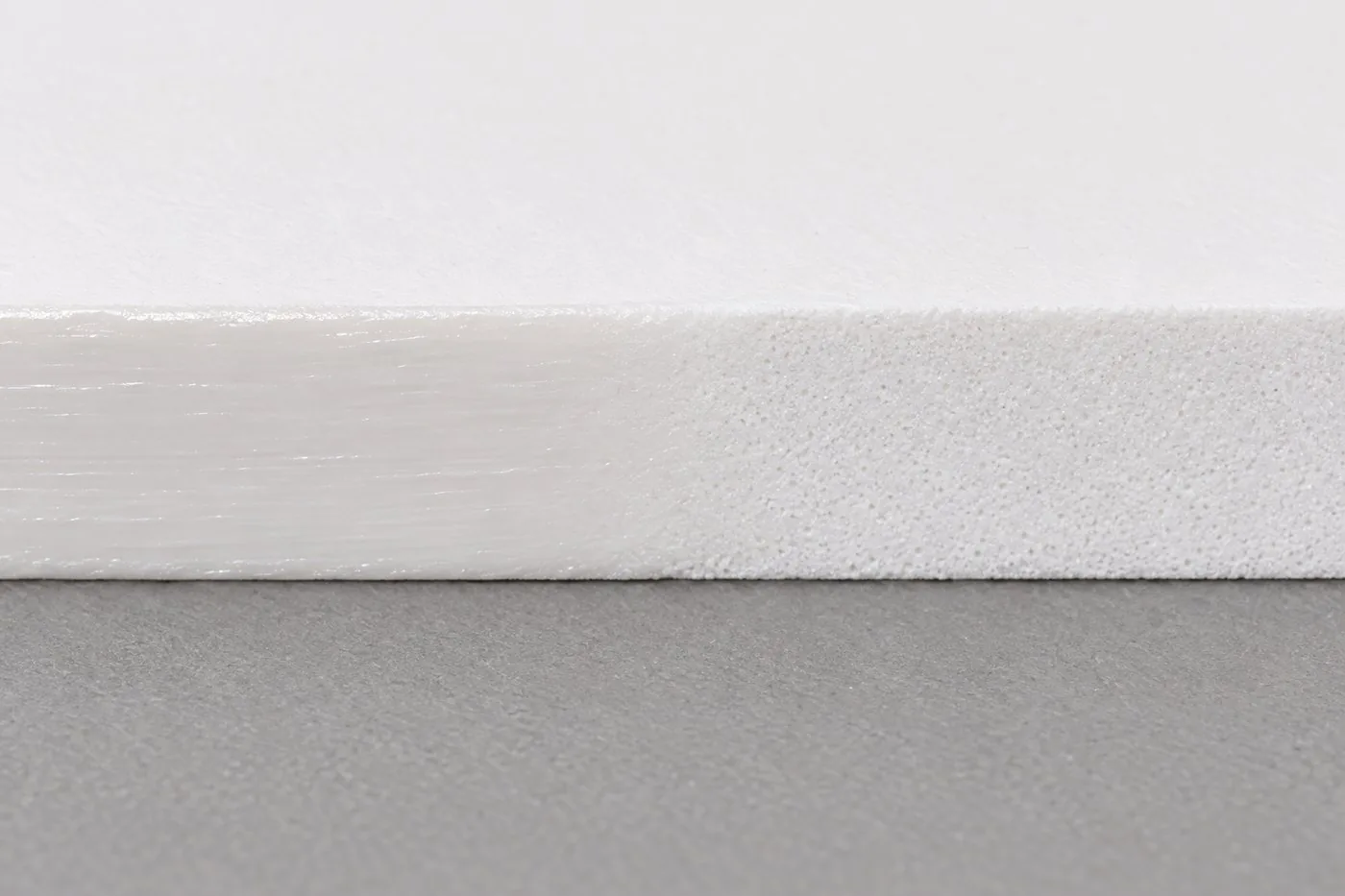
Expanded PVC (foam board) is light, with a matte surface and a fine foam core. It is the board signs and displays are made from.
Rigid PVC (Type 1) is solid, dense, and about twice the weight of foam board. It is the gray sheet used for machined parts, brackets, and enclosures.
If you are not sure which you have, compare the weight and look at a cut edge. Foam board shows a fine foam core. Rigid PVC is solid all the way through.
Why heat matters with PVC
PVC softens with friction, the same as other plastics. A blade that rubs smears the edge and leaves it hard and glazed.
PVC also has a second reason to stay cool. Overheated PVC breaks down and gives off the same gas a laser releases from it. A sharp tool at a steady feed stays well clear of that. If a cut ever smokes or browns the edge, stop and fix the cause before going on.
The blade rule follows from the heat. Every tooth rubs as well as cuts, so a blade with fewer teeth runs cooler than a fine one. Foam PVC makers put it the same way: fine-tooth blades are unsuitable because the closer tooth spacing creates too much friction.
What you need
- Eye protection, for every cut
- A dust mask, and a shop vacuum
- Clamps and a flat, solid work surface
- For foam board up to 1/8": a utility knife with fresh blades, a metal straightedge, and a cutting mat or scrap board
- For thicker foam board and rigid PVC: a table saw, or a circular saw with a clamped guide, and a sharp carbide blade with a triple-chip grind
- For shapes: a router with a sharp carbide bit, or a band saw
- Sandpaper on a block, and a scraper for rigid PVC
How do you cut PVC foam board?
With a knife (up to 1/8")
Foam PVC makers' fabrication guides list knife cutting for board up to 3 mm, which is about 1/8".
- Lay the sheet on a cutting mat or scrap board. Hold a metal straightedge firmly on the line, with your fingers behind its edge.
- Make a light first pass to set the line.
- Repeat in the same groove until the blade is through. Several light passes cut straighter than one heavy one. Hold the blade at a low angle to the board, which reduces drag.
Change the blade as soon as it drags. A dull blade tears the foam core. Use a thin, very sharp blade.
Thicker foam board goes on a saw.
With a saw
Foam board saws easily on a table saw, or with a circular saw along a clamped guide.
- Blade. Carbide-tipped, with a triple-chip grind or sold as plastic-cutting. That is the makers' recommendation. A fine-tooth blade rubs, and the edge melts glossy and hard.
- Hold it down. Foam board is light and lifts easily. Keep it flat to the table, or clamp it.
- Feed steadily, and do not stop in the cut.
- With a circular saw, cut on a sacrificial backer board so both sides stay supported.
Shapes in foam board
A router cuts shapes and lettering from a template. Use a sharp carbide bit and keep moving. Foam board is soft, so the bit cuts fast, and a pause leaves a melted mark. A band saw also cuts curves and leaves an edge that needs little finishing.
How do you cut rigid PVC sheet?
Rigid PVC is cut on a saw or with a router.
Table saw or circular saw
- Blade. A sharp carbide triple-chip blade. For the heat reasons above, choose fewer teeth over more.
- Feed. Steady, in one pass. A slow feed smears the edge.
- Support. Clamp the sheet and support both sides of the cut to the end, so the offcut cannot drop.
- Weight. Rigid PVC is heavy. Use roller stands or a second pair of hands on large pieces, so the sheet stays flat through the whole cut.
Router
Rigid PVC machines well. A router with a sharp carbide bit trims it to a square edge, cuts rabbets and slots, and follows a template. Take thick sheet in several shallow passes, and keep the chips clearing.
Band saw
For curves and thick sheet, a band saw runs cooler than most saws, because each tooth spends most of its trip out of the cut. Use a blade coarse enough to clear its chips.
What about a jigsaw or a rotary tool?
Foam PVC makers do list the jigsaw for curves and intricate shapes in foam board, and say it is no good for a straight cut. Use a rough-cut blade ground for plastics. A smooth metal-cutting blade gives a poor result, because it rubs. Clamp close to the line and keep the saw moving.
On rigid PVC, a jigsaw holds a small blade in a thick cut and builds heat, which is the thing to avoid with this material. Use a band saw or a router for curves. A rotary tool has the same problem on either kind of PVC. Stop if a cut smokes.
A guillotine or power shear is not recommended for foam board. It crushes the edge.
How do you finish a cut PVC edge?
Foam board. Sand the edge lightly with fine sandpaper on a block to take off fuzz and saw marks, and ease the sharp corner with one light pass. Foam board cannot be polished. The foam core does not take a finish.
Rigid PVC. Scrape off the burr, then sand with a block from a medium grit to a fine one. This gives a smooth, even edge.
Keep flame and heat away from PVC edges, for the same reason as the laser.
Dust and cleanup
Sawing and sanding PVC makes fine dust that clings to everything. Wear a dust mask, connect a vacuum to the tool if it has a port, and vacuum the bench afterward. Do not blow the dust around with compressed air.
Mistakes to avoid
- Using a laser or any other tool that cuts by heat. Never, on any PVC.
- Using a fine-tooth blade. It rubs, and the edge melts.
- Feeding slowly or stopping in the cut. Same result.
- Cutting foam board in one heavy knife stroke. The blade wanders and the core tears.
- Keeping a dull knife blade. Change it as soon as it drags.
- Letting foam board lift on the saw. The cut goes out of square.
- Leaving foam board near heat. It softens at around 150°F. Keep cut pieces out of a hot vehicle and away from heaters.
Or have it cut for you
We cut both kinds of PVC to the size you enter, on a saw, with a square edge. Type your dimensions and the price shows as you type. There is no minimum order.
- Expanded PVC (foam board) comes in white and black from 1/8" to 1", and in more colors in the thinner sheets. It is sold saw cut only, because foam board cannot be polished.
- Rigid PVC (Type 1) comes in gray from 1/4" to 1-3/4". A saw-cut edge is included, and a diamond-polished edge is available.
For holes, notches, or curves, request a quote. We ship to the contiguous US. Pieces are cut to your dimensions, so check your measurements before you order. The details are on the returns page.
Related guides
FAQ
Can you laser cut PVC?
No, never. Lasering PVC releases hydrogen chloride gas, which forms hydrochloric acid with moisture. It is dangerous to breathe, and it corrodes the laser from the inside. This applies to foam board and rigid PVC alike. Cut PVC with a knife, a saw, or a router.
What is the best way to cut PVC foam board?
For board up to 1/8", a sharp utility knife and a metal straightedge, in several light passes. For thicker board, a table saw, or a circular saw on a guide, with a carbide triple-chip blade. For shapes, a router and a template.
Can you cut PVC sheet with a utility knife?
Foam board up to about 1/8" (3 mm), yes. That is the limit in foam PVC makers' fabrication guides. Thicker foam board and rigid PVC are cut on a saw.
What saw blade should you use for PVC sheet?
A carbide-tipped blade with a triple-chip grind, or one sold as plastic-cutting. Avoid fine-tooth blades: the closer tooth spacing creates friction, and PVC smears when it gets hot.
Why is the edge of my PVC melting when I saw it?
Friction heat. The usual causes are a fine-tooth blade, a dull blade, a slow feed, or stopping in the cut. If the cut smokes or browns the edge, stop and fix the cause.
Can PVC edges be polished?
Rigid PVC can be sanded smooth, and it can be diamond polished. Foam board cannot be polished, because its foam core does not take a finish. Keep flame away from both.
Sources
Foam PVC sheet manufacturers' published fabrication guides.
- 3A Composites USA, The Expanded PVC Collection Fabrication Guide (October 2020). Published by 3A Composites USA (3acompositesusa.com).
- Vycom, Celtec Expanded PVC fabrication manual (2023). https://plaskolite.com/docs/default-source/fab/fab053_vyc_celtec.pdf