How to Cut Polycarbonate Sheet With Less Melting and Burr
Cut polycarbonate on a table saw, or with a circular saw run along a clamped guide. Use a sharp carbide blade with a triple-chip grind and feed at a steady pace. If the edge melts, go to a blade with fewer, larger teeth. Cut curves with a router or a band saw. Never put polycarbonate in a laser.
Lexan is a brand name for polycarbonate, so this guide covers both.
What makes polycarbonate different to cut?
Polycarbonate is tough. It is far less likely to crack than acrylic, so cracking is not the main risk when you saw it.
Heat is. Polycarbonate softens under a rubbing blade, smears onto the teeth, and comes off in strings instead of chips. It also leaves a raised burr along the cut. And thin sheet flexes, so a blade can grab it and make it flap.
The fix for heat is the same as for acrylic. Every tooth rubs as well as cuts, so more teeth mean more contact and less time for the plastic to cool between them. A blade with fewer teeth runs cooler. Polycarbonate sheet makers say the same in their troubleshooting tables: for a melted or gummed edge, use a larger tooth and feed faster.
What you need
- Eye protection, for every cut
- A table saw, or a circular saw with a straightedge guide and clamps
- A sharp carbide blade with a triple-chip grind
- Flat backer boards, to support thin sheet and to cut on
- For curves: a router with a sharp carbide bit, or a band saw
- A deburring tool or sharp scraper, and wet-and-dry sandpaper on a block
Before any cut
- Leave the masking on. Polycarbonate scratches more easily than acrylic. The masking protects both faces from the saw table and the bench.
- Hold it flat and still. Clamp the sheet, and support it close to the cut on both sides.
- Check the blade is sharp. A dull blade is the most common cause of a melted edge.
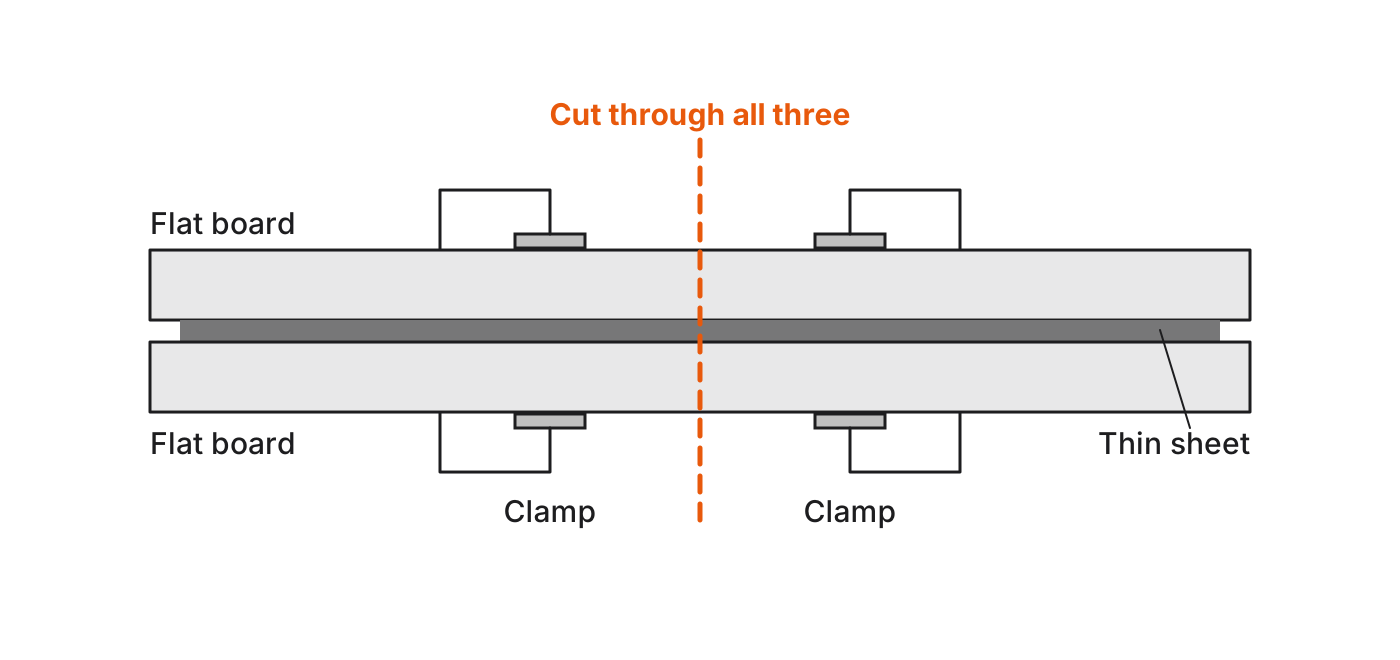
- Support thin sheet right at the blade. Thin sheet needs a firm supporting edge with almost no gap beside the blade. A backer board under the sheet, cut through with it, does this.
Which method suits which job?
| Method | Use it for | Watch for |
|---|---|---|
| Table saw | Straight cuts | Thin sheet needs support at the blade |
| Circular saw on a guide | Straight cuts in large pieces | Needs full support under the sheet |
| Router | Curves, shapes, and clean square edges | Sharp tooling; do not pause |
| Band saw | Curves and thick stock | Edge needs deburring |
| Shear | Thin sheet, in a shop with a power shear | Burred, stressed edge that should be saw trimmed |
| Jigsaw | Curves in thin sheet | Clamp close to the line; heat |
| Scoring and snapping | Not recommended | It bends and tears |
| Laser | Never | Scorches, fumes, and can catch fire |
How do you cut polycarbonate with a table saw or circular saw?
Use a carbide blade with a triple-chip grind. Polycarbonate sheet makers agree on this: carbide-tipped teeth, with alternate teeth beveled.
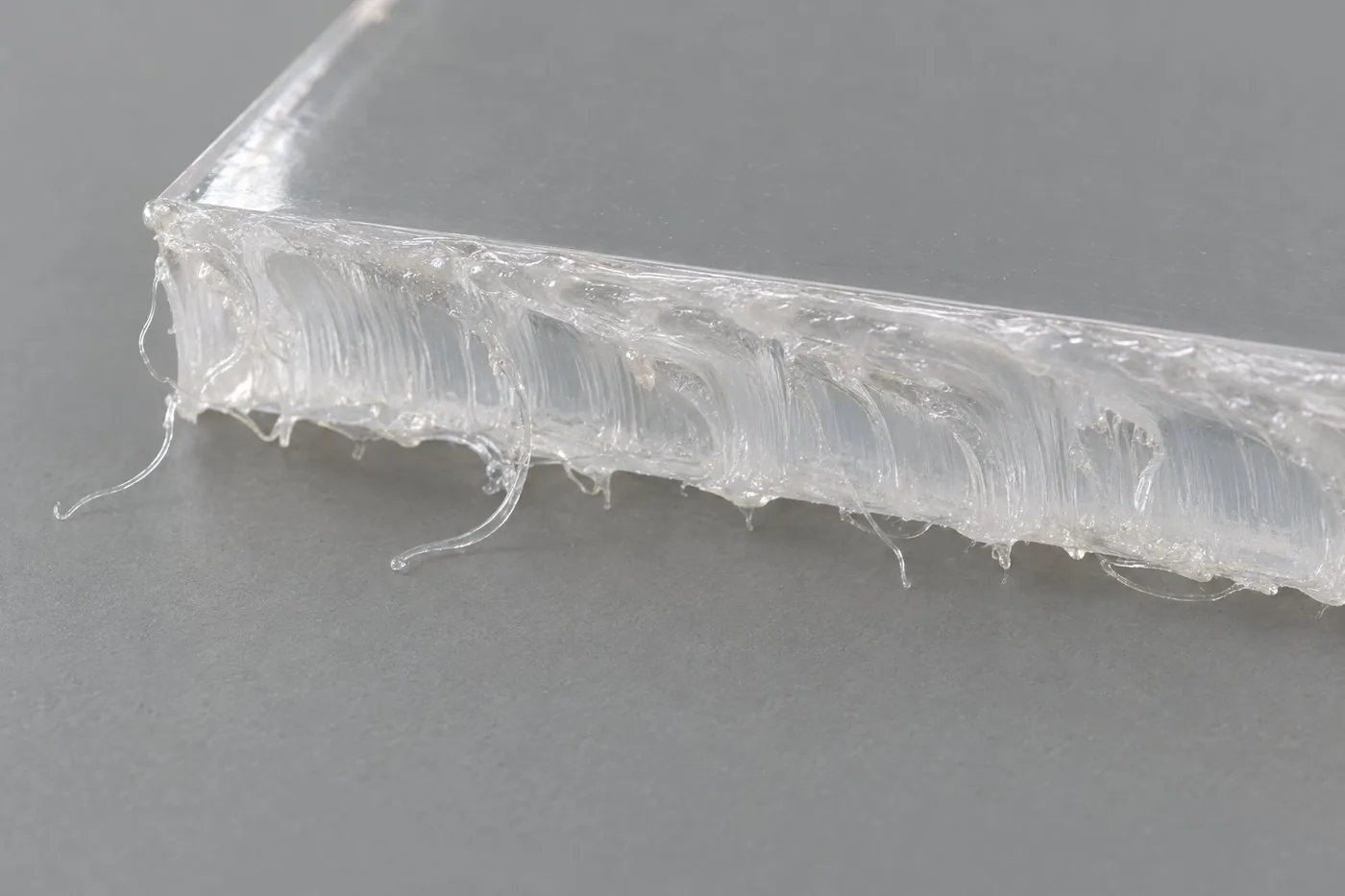
Choose the tooth count by what the edge tells you. The makers' published tooth figures do not agree with each other, so we do not give one number. What they do agree on is the direction:
| If the edge is | Makers' guides say |
|---|---|
| Melted or gummed | Use a larger tooth (fewer teeth), feed faster, cool the blade with air, and check the blade is sharp |
| Chipped | Use a smaller tooth, slow the feed, and improve the clamping and support |
That is the heat rule again. Start with a blade that has fewer teeth, and go finer only if the edge chips. One maker's tooth spacing works out to roughly 55 to 90 teeth on a 10" blade, by our arithmetic. That is the same range as the blade table in how to cut acrylic sheet, which is a reasonable starting point by saw.
Feed at a steady pace, and do not stop in the cut. If the blade dwells, the plastic softens and builds up on the teeth.
Support thin sheet. On a table saw, thin sheet needs a firm supporting edge with a minimal gap between the blade and the table. Use a zero-clearance insert, or lay the sheet on a flat backer board and cut through both. One sheet maker advises a band saw in place of a circular saw for single sheets under about 1/8".
With a circular saw, clamp a straightedge as a guide. Rest the sheet on a sacrificial backer board or a sheet of rigid foam, and set the blade to cut just into it. Both sides then stay supported to the end of the cut.
Let the blade reach full speed before it touches the sheet.
How do you cut curves in polycarbonate?
Router
A router trims polycarbonate to a square edge and follows a template for repeat shapes. Use a sharp carbide bit with one or two flutes. The saw rule applies: fewer cutting edges run cooler and clear chips better. Feed against the rotation of the bit, and keep moving. Rough-cut close to the line first, and let the router take the last light pass.
Band saw
Sheet makers prefer a band saw for contours and irregular shapes. Use fewer teeth per inch as the sheet gets thicker. Their figures are 8 to 12 teeth per inch for sheet under 1/8", 5 to 6 for 1/8" to 1/4", and 3 to 4 for thicker sheet, with skip-tooth blades above 1/8". Support the sheet close to the blade, and deburr the edge afterward.
Can you cut polycarbonate with a jigsaw?
Yes, for curves in thin sheet. It is not how a shop cuts a straight line, but polycarbonate makers do list it, and the sheet is unlikely to crack if the blade catches.
What matters most is support and clamping. Clamp the sheet close to the cut line so it cannot bounce with the blade. Use a blade with about 10 to 12 teeth per inch, and keep the feed low and steady. If the kerf starts welding shut behind the blade, the cut is too hot: stop and let it cool.
Can you shear thin polycarbonate?
A shop with a power shear can shear polycarbonate up to about 1/4" thick. The sheet makers who describe it also say what it costs: a sheared edge is burred, rolled, and highly stressed, and it should be trimmed back on a saw so it does not crack later. Hand snips do the same damage on a smaller scale. For a part you care about, saw it.
Can you score and snap polycarbonate?
No. Polycarbonate bends where acrylic breaks, so a scored sheet folds, turns white along the line, and tears. Use a saw.
Can you laser cut polycarbonate?
No. Polycarbonate scorches brown along the cut, melts and welds itself back together, and gives off fumes you should not breathe. It can catch fire, and it coats the machine's optics. This is true of CO2 and diode lasers alike, at every thickness. It is not a settings problem. Polycarbonate sheet makers' own guides warn that laser-cut edges turn amber or brown, and one advises against laser cutting outright because of rough edges, carbon on the cut, and added stress.
If the part needs to come off a laser, use acrylic instead. The differences between the two materials are in acrylic vs. polycarbonate.
How do you finish a cut edge?
A saw leaves polycarbonate with a square edge and a burr on one or both faces.
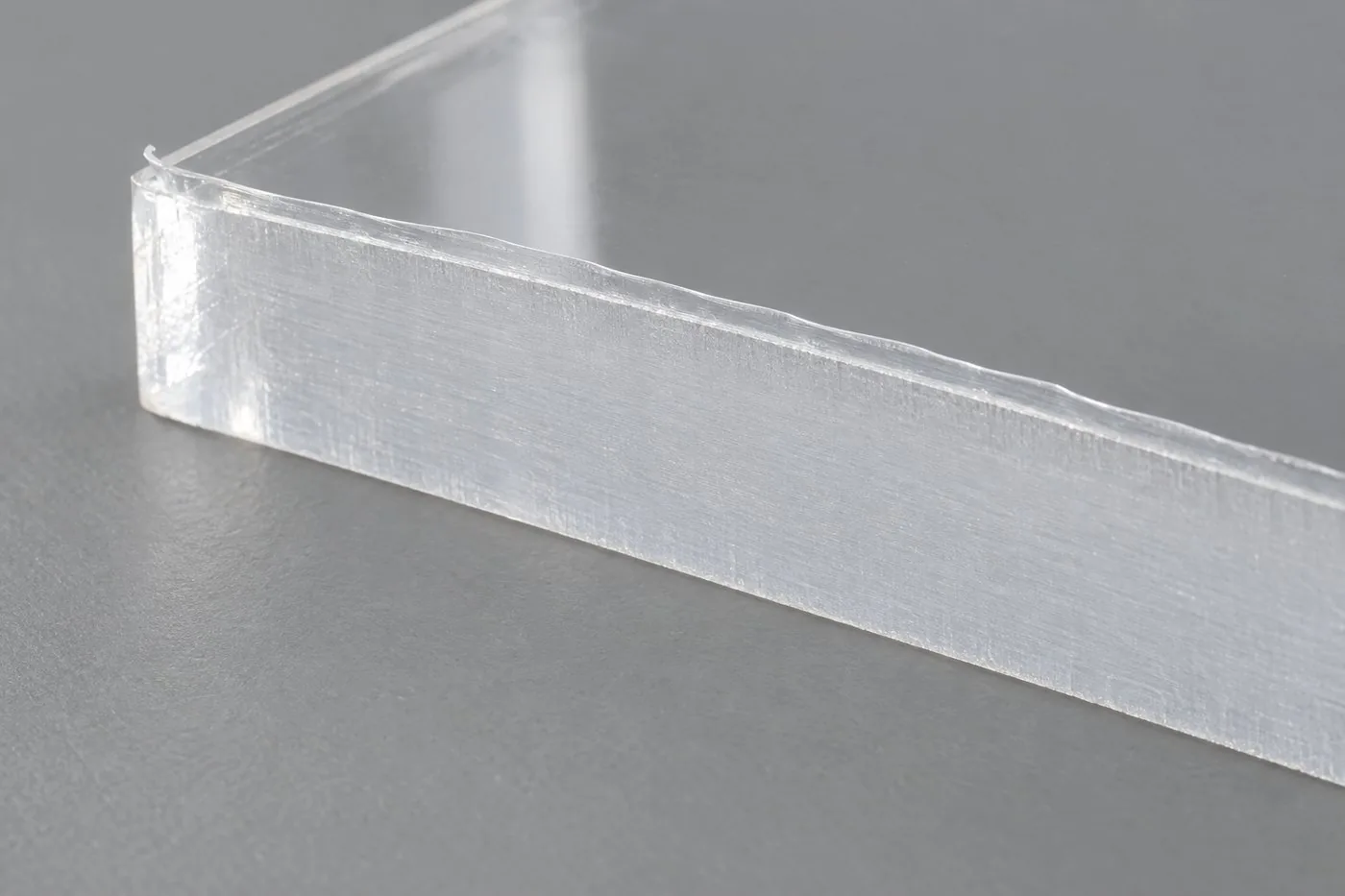
- Deburr. Run a deburring tool or a sharp scraper along each corner of the edge at a low angle. The burr comes off in a ribbon.
- Scrape off any saw marks you want gone.
- Sand wet with wet-and-dry paper on a block, from a medium grit to a fine one. This gives a smooth satin edge.
Keep a torch away from a polycarbonate edge. Heat scorches and yellows it.
Mistakes to avoid
- Putting it in a laser. See above.
- Answering a melted edge with a finer blade. Makers' guides say the opposite: a larger tooth and a faster feed.
- Using a dull blade. Same result.
- Letting thin sheet flap. Support it right at the blade and clamp it.
- Stopping in the cut. The blade heats the kerf where it sits.
- Peeling the masking early. Polycarbonate picks up scratches easily.
- Leaving the burr. It catches on everything, and it is sharp enough to scratch.
- Trying to snap it like glass. It folds and tears.
Or have it cut for you
We cut polycarbonate to the size you enter, in clear from 1/32" to 1" thick, and in several colors. Type your dimensions and the price shows as you type. Every piece is cut on a saw, never a laser. A saw-cut edge is included, and a diamond-polished edge is available. There is no minimum order.
That covers rectangles. For holes, notches, or curves, request a quote. We ship to the contiguous US. Pieces are cut to your dimensions, so check your measurements before you order. The details are on the returns page.
Shop polycarbonate cut to size · Custom cut Lexan
Related guides
FAQ
What is the best way to cut polycarbonate sheet?
A table saw, or a circular saw run along a clamped guide, with a sharp carbide triple-chip blade, fed at a steady pace. Use a router or band saw for curves.
What saw blade is best for polycarbonate?
A sharp carbide blade with a triple-chip grind. If the edge melts or gums, sheet makers' guides say to go to a larger tooth, which means fewer teeth, and to feed faster. If it chips, go finer and slow the feed.
How do you cut thin polycarbonate sheet?
Support it right at the blade. On a table saw, use a zero-clearance insert or cut it on a backer board. One sheet maker recommends a band saw over a circular saw for single sheets under about 1/8".
Is polycarbonate likely to crack when you cut it?
Much less likely than acrylic. Polycarbonate is tough and bends before it breaks. The usual problems are a melted, smeared edge from heat and a burr along the cut.
Can you score and snap polycarbonate like glass?
No. It bends and tears along the score instead of snapping. Use a saw.
Can polycarbonate be laser cut?
No. It scorches, gives off harmful fumes, can catch fire, and coats the machine's optics. Cut it with a saw or a router. If the part must be laser cut, use acrylic.
Sources
Polycarbonate sheet manufacturers' published fabrication guides.
- Plaskolite, TUFFAK Polycarbonate Sheet Fabrication Guide (2024). https://plaskolite.com/docs/default-source/fab/fab015_tuf_en.pdf
- Covestro, Makrolon Polycarbonate Sheet Fabrication Guide (2015). Published by Covestro (sheets.covestro.com).
- SABIC (formerly GE Structured Products), Lexan Sheet Processing Guide.